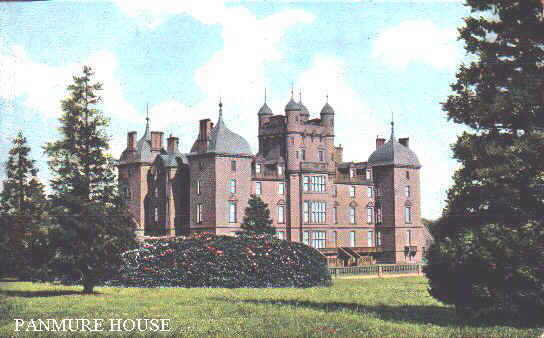
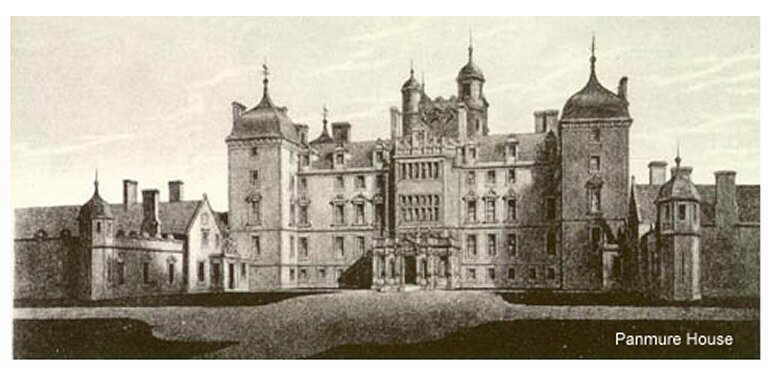
The Scottish Chateau
Plans of Panmure, taken from Vitruvius Scoticus. William Adam was planning the publication of a volume of drawings like Vitruvius Scoticus from 1726 and material was prepared from the following year onwards. It was not published until 1812, however.
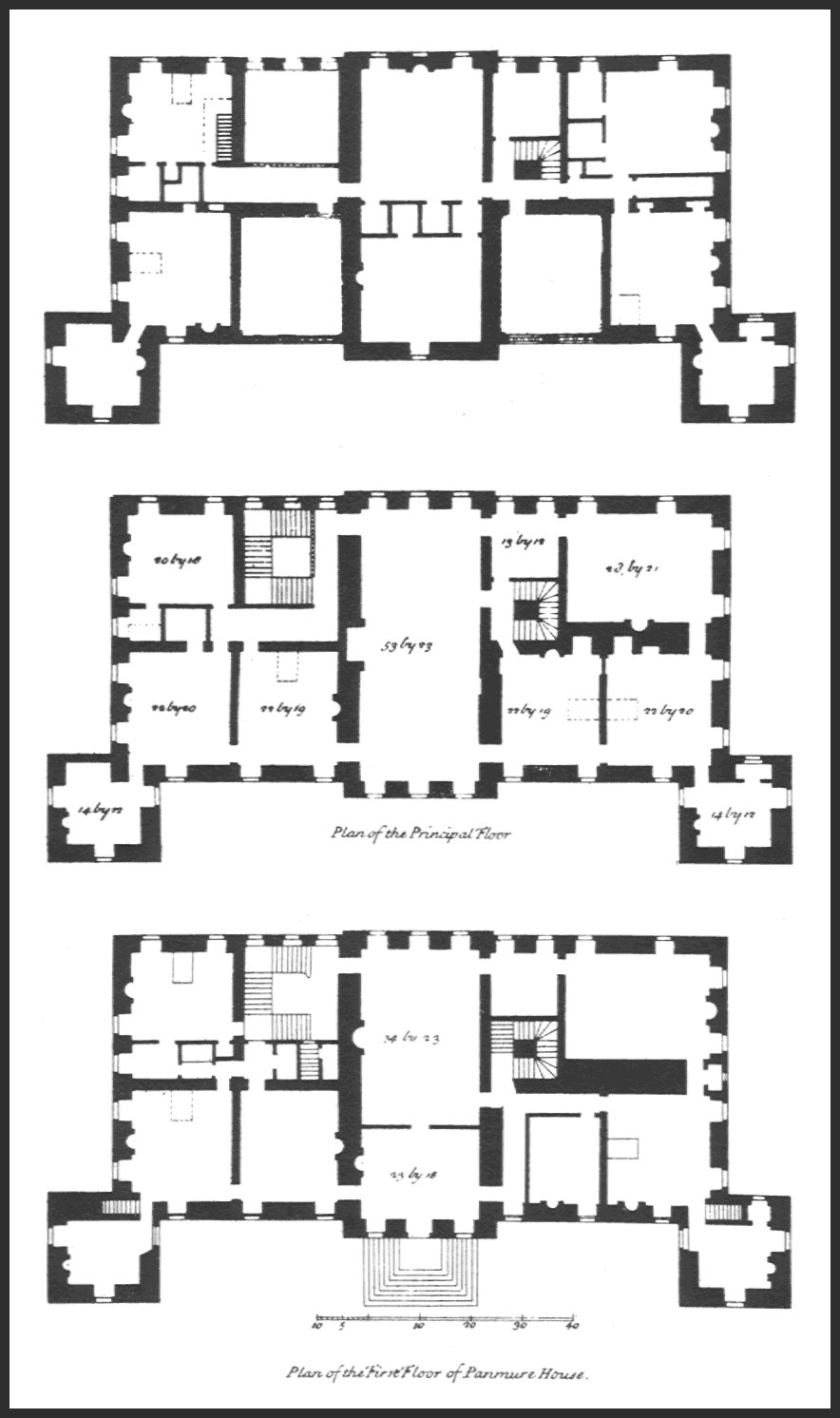
(This graphic may be
enlarged)
The way in which Scottish architecture was evolving was more
apparent in new-build, or where sufficient of an extension occurred as
to make virtually a new house. In April 1666 the Earl of Panmure
determined upon a new house, probably incorporating the mansion of Bowshen
in which he was then living, and contracted with John Milne, Master Mason to the Crown, to have it built. Although Milne appears to have been both designer and main contractor for the
structure, Sir William Bruce certainly designed the chief entry into the court from the west in 1672. Moreover, the design of
Panmure displays so great a resemblance to Bruce's contemporary transformation of his own house at
Balcaskie as to indicate Bruce's design hand in the former as well. To an existing
thick-walled L-plan house on the east, the earl added a balancing structure to the west, regularised it and framed the conception by square
five-storeyed, ogee-roofed closet towers projecting beyond the corners. The spreading eleven-bay horizontally proportioned house was firmly symmetrical, organised around the three-bay centre, flanked and framed like a coronet by taller chimneystacks. Although
Panmure's entrance was up a flight of steps above the kitchen/basement level, the principal floor still lay on the floor above. The saloon, which occupied the entire centre front to back, separated the two wings of the house which, to judge by the staircases, were the family wing to the right, and guests' to the left. The entrance
façade, enormous chimneys, corner towers and half gables were a new formalisation of the inherited Scottish architectural tradition. At the third storey, the roof was pulled back to each side in order to provide a viewing platform on either side of the centre. This array of chimneys and gables echoed the martial skyline of the older
châteaux, even though everything of which it was composed had an overtly peaceable purpose.
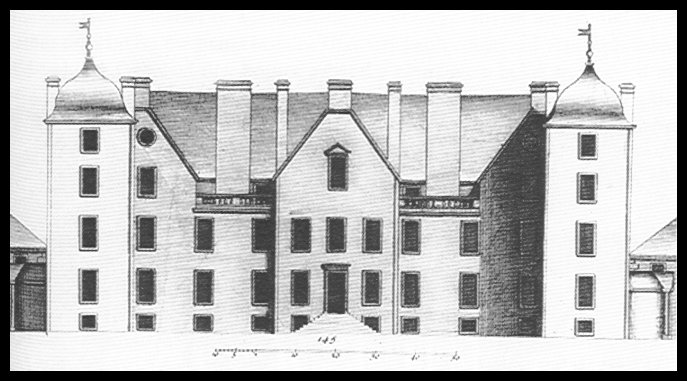
Entrance elevation of Panmure, William Adam, c.1730.
Bruce's own more or less contemporary house of Balcaskie, Fife, c.1668, was remarkably similar. Likewise eleven bays long and extended from an
L-plan house, the addition of a main house and balancing eastern wing produced a northern elevation of gables and chimney-stacks in approximate symmetry and perfect balance. Unlike
Panmure, its corner towers are lower than the main house, and there was
no formal array of chimney-stacks around the centre. None the less
. . . .(continued)
|